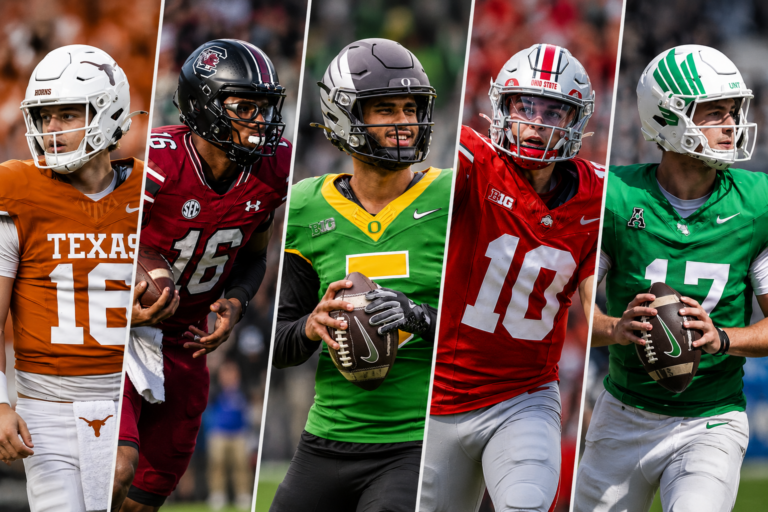
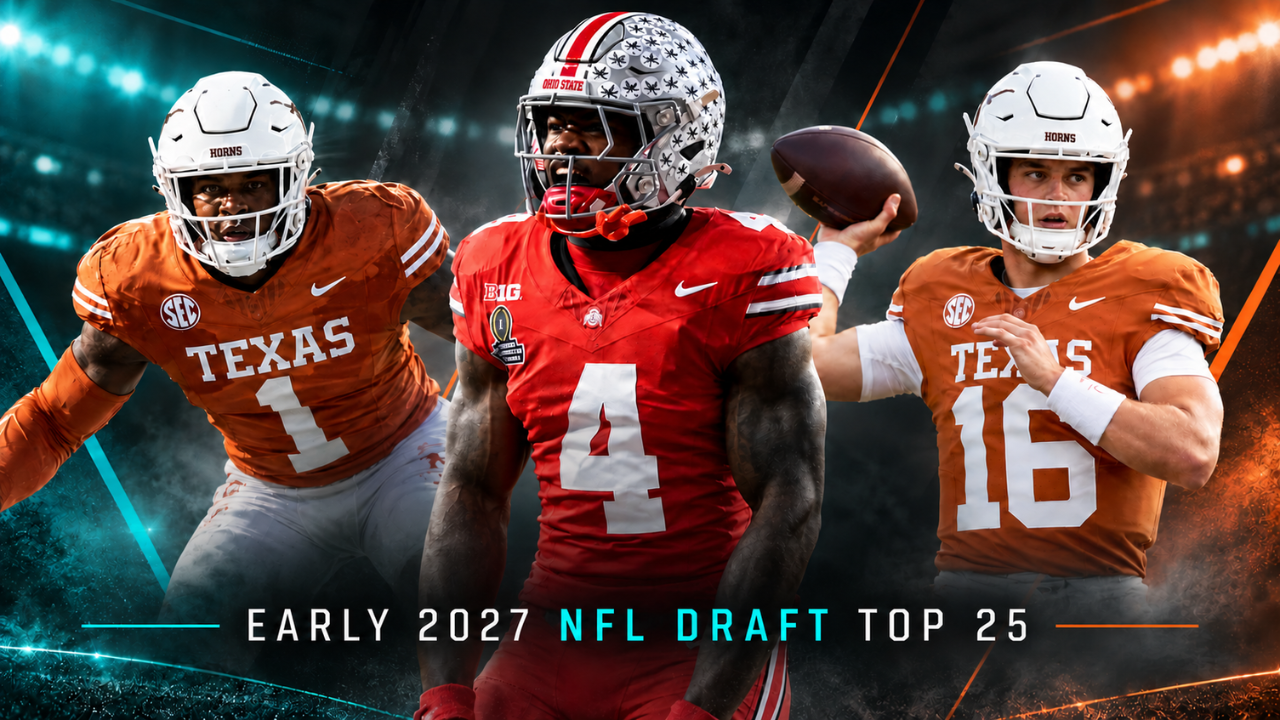
My early 2027 NFL Draft Top 25: Names Dolphins fans need to know
College football is back, and so is Fins Faithful draft coverage. Here is my early 2027 NFL Draft board.
This is not a mock draft or a list based only on what the Miami Dolphins may need. These are the 25 best draft-eligible prospects I see right now. It’s September, so this board will change as we get more film and learn more about these players throughout the season. The NFL comparisons are about traits and playing style, not me predicting what somebody’s entire career will become.
Nos. 25–21
25. Will Heldt, EDGE, Clemson
Heldt may be higher on my board than he is elsewhere, but I’m buying the size, length and the way he plays every snap. At 6-foot-6 and 260 pounds, he can collapse a tight end, fight through extra attention and keep the edge from moving. His 15.5 tackles for loss and 7.5 sacks show that the power creates production. He is not the bendiest pass rusher in this class, but that is not his game. There is a little Joey Bosa in the way he wins with strength, length and relentless effort.
24. Kade Pieper, C, Iowa
Pieper is undersized for an NFL interior lineman at 6-foot-3 and 298 pounds, and you do see moments when a bigger defensive lineman can test his anchor. Pound for pound, though, few linemen in this class are stronger. The lower-body power jumps out, and he has the athletic ability to reach defenders and climb quickly. PFF gave him an 83.6 overall grade and an 83.5 run-blocking grade last season, both fifth among FBS guards. Now he moves from right guard to center, and honestly, that may end up being his best position in the NFL.
23. Greg Johnson, OL, Minnesota
The first thing with Johnson is that the versatility is real. This is not one of those cases where we say a player can line up everywhere because he took a few practice snaps at another position. Johnson started at center throughout 2024, then opened 11 games at left guard and one at each tackle spot last season. At 6-foot-6 and 325 pounds, he has strong hands, real upper-body power and good enough feet to stay in front of people. I’m not sure yet where he fits best, but he looks like the kind of high-floor lineman an NFL coaching staff will trust.
22. Jadan Baugh, RB, Florida
First of all, Baugh looks like an NFL lead back. He’s 6-foot-1 and 225 pounds, but the feet are what really separate him. You watch him press the line, influence a linebacker and wait for the opening without becoming hesitant. That is not easy for a back his size. I see some prime Le’Veon Bell in the patience and stop-start ability, while Florida’s Wildcat usage gives me a little Ronnie Brown. Baugh rushed for 1,170 yards and eight touchdowns as a true sophomore. Kewan Lacy is close, but Baugh’s combination of size and movement gives him the advantage on my board.
21. Ashton Hampton, CB, Clemson
Hampton looks like an outside NFL corner at 6-foot-2 and 205 pounds. What caught my attention is how much of the rep he can win before the route really gets going. He lands his hands, changes the receiver’s path and disrupts the timing of the play. He also finds the football, contributing 11 pass breakups last season, and he is not afraid to come downhill and tackle. I want to see how he handles smaller, quicker receivers who can challenge his change of direction. But when you start with that length, physicality and ball awareness, there is a lot to work with.
Watch my full breakdown of the early 2027 NFL Draft Top 25 below.
Nos. 20–16
20. David Stone, DT, Oklahoma
Stone’s first step is too quick for a 6-foot-3, 315-pound defensive lineman. You see him slip a block, cross a blocker’s face and move down the line, but he still has enough strength to hold his ground against the run. Oklahoma can move him around, too, which adds to the appeal. The question I kept coming back to was how all that movement and disruption produced only 1.5 sacks last season. The ability is there, but now he has to finish more of those rushes. If the sack total starts matching what we see on film, Stone will move higher on this board.
19. KJ Bolden, S, Georgia
Some players jump out because of how fast they run. With Bolden, I kept noticing how quickly he understood what was happening. He reads the quarterback, understands leverage and seems to arrive where the offense is trying to go. At 6 feet and 195 pounds, he can play from depth or come into the box, and that gives a defensive coordinator options. He is not the biggest safety in the class, but his anticipation allows him to play fast. Some defenders spend the play chasing the action. Bolden has a way of meeting it.
18. A’Mauri Washington, DT, Oregon
Man, Washington is 325 pounds, and he should not move the way he does. That is the first thing that hits you. His first step, quick hands and lateral agility allow him to slip blocks instead of just sitting there and absorbing them. Then you see the power when he decides to hold the point of attack. Washington started all 15 games last season and batted eight passes, tying for the most among FBS defensive linemen. The pass-rush flashes look better than 1.5 sacks. Now I want to see him turn more of those flashes into finished plays.
17. Sammy Brown, LB, Clemson
I have developed a reputation for trusting my linebacker evaluations, from Carson Schwesinger to Jacob Rodriguez. Brown is not quite in that category for me yet, but he could get there. He sees it, triggers quickly and attacks downhill, and the important part is that he usually closes under control. PFF charted a 6.1% missed-tackle rate to go with 107 tackles, 13.5 tackles for loss and five sacks. That is real production. I want more evidence of what he can consistently do in coverage. If that part comes together, we are talking about a complete three-down linebacker.
16. Brauntae “Tae” Johnson, S, Notre Dame
Johnson may be the best open-field tackler in this class. You watch him see the action in front of him, trigger without wasting steps and get the ball carrier on the ground. It sounds simple, but man, a lot of defenders do not do it this consistently. His 6-foot-2, 200-pound frame and versatility allow Notre Dame to use him deep, in the box or over the slot. Four interceptions last season showed he can affect the passing game, too. The question is availability after foot surgery limited him in 2024 and a hand injury cut his 2025 season short. Healthy, Johnson has first-round ability.
Nos. 15–11
15. Trevor Lauck, OT, Iowa
Lauck is exactly what people picture when they hear “Iowa offensive lineman.” He’s 6-foot-5 and 314 pounds, technically sound, powerful in the running game and rarely looks overwhelmed. His feet are not special, but they are good enough because he understands positioning and plays with strength. After starting all 13 games at left tackle in his first season atop the depth chart, I could eventually see him settling on the right side in the NFL. The Brian Bulaga resemblance comes from the style and projection: tough, dependable and the kind of lineman who could quietly start for a long time.
14. Drew Mestemaker, QB, Oklahoma State
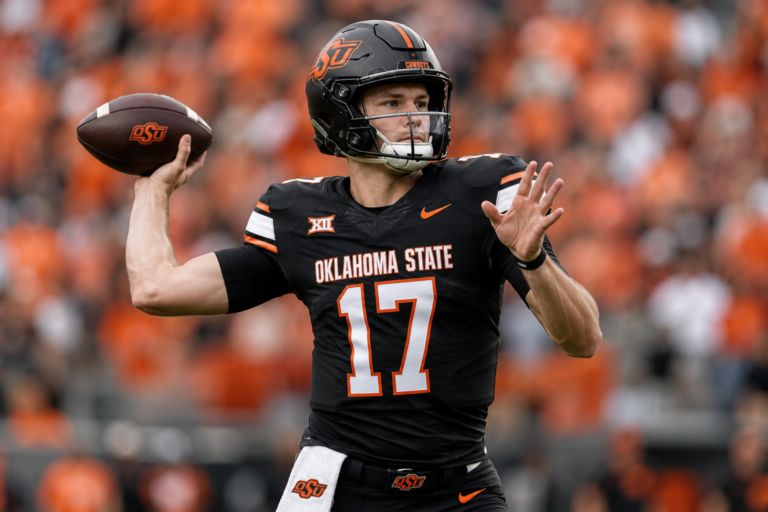
Mestemaker is probably my biggest conviction ranking. When I first put on the film, the life coming out of his arm immediately caught my attention. But the more I watched, the anticipation may have impressed me even more than the velocity. He trusts what he sees and lets the ball go before the window closes. He can also create when the original play breaks down. Mestemaker led the FBS with 4,379 passing yards while throwing 34 touchdowns and completing 68.9% of his attempts at North Texas. Oklahoma State is a much tougher test. If the same player shows up there, he will not stay at No. 14.
13. Jordan Seaton, OT, LSU
You put on the film, and the first thing that jumps out with Seaton is how fast he moves at 6-foot-5 and 311 pounds. Watch him pull and get into space. Man, he flies at you. That athletic ability also shows up in pass protection, where he can mirror speed and recover after losing the start of a rep. The hand placement and down-to-down run blocking still need work. But the former No. 1 tackle recruit now goes from Colorado to LSU, and the ability is obvious. If LSU can put the complete package together, we’re talking about a legitimate first-round left tackle.
12. Trey’Dez Green, TE, LSU
You see the LSU basketball background immediately when you watch Green. At 6-foot-7 and 242 pounds, he knows how to use his body, box out a defender and attack the football at its highest point. It looks natural to him, and there are not many defenders who will have an answer for that near the goal line. Green caught eight passes for 119 yards and a touchdown against South Carolina, then scored twice against Houston in the Texas Bowl. His seven touchdown receptions set LSU’s single-season record for a tight end. He still has to develop as a blocker, but these are rare mismatch traits.
11. Ellis Robinson IV, CB, Georgia
Robinson plays with much more force than you expect from a 180-pound corner. The Alabama tape really stood out to me. He challenged Germie Bernard, competed with Ryan Coleman-Williams and never backed away from the matchup. That tells you something about him. Robinson closes aggressively, tracks the deep ball and attacks it with confidence. He intercepted four passes and tied for the SEC lead last season. Yes, that aggression will occasionally get him into trouble. But I would much rather teach a confident corner when to pull back than try to manufacture that confidence after he reaches the NFL.
Nos. 10–6
10. Will Echoles, DT, Ole Miss
The pressure separates Echoles, man. We’re talking about a 315-pound interior defender who led all Power Four defensive tackles with 39 pressures. That is rare, and when you put on the film, you understand how it happens. He changes direction, works laterally and gets through a gap before the blocker can square him up. Go back to the safety against Oklahoma. That one play shows you the movement, penetration, power and finish. Echoles entered college as an offensive-line recruit. Now it is his ability to get after quarterbacks that puts him inside my top 10.
9. Charlie Becker, WR, Indiana
Becker is 6-foot-4 and 208 pounds, and he treats contested passes like they belong to him. That was the first thing that caught my attention. He tracks the deep ball, plays through contact and becomes a physical runner after the catch. But the reason he is this high on my board is that he is more than a jump-ball receiver. He understands spacing, does not waste much movement, and separates better than people may expect at that size. I see some Puka Nacua flavor in the physicality, route feel and work after the catch. Now he gets Josh Hoover at quarterback and another chance to prove the ranking.
8. Trevor Goosby, OT, Texas
Goosby looks like a franchise left tackle when he walks onto the field, and then you see him move. At 6-foot-7 and 325 pounds, he has the reach to protect the corner, but his feet are light enough to stay with speed and recover when a rusher gains an early advantage. His hands may be what I like most. He strikes first, works inside and uses his length to control the rep instead of just hanging on. A full 13-game season at left tackle gave us more evidence, although the technique is not finished. Plenty of tackles are long. Not many move the way Goosby does.
7. Dante Moore, QB, Oregon
Moore may have the widest possible range on my board. I could see him sliding a few spots, or I could see him finishing the season as QB1 and challenging for the top overall pick. The ball comes out effortlessly. His base is generally calm, and he layers throws with the kind of touch you usually see from a more experienced quarterback. There are moments when I watch Moore and get a little C.J. Stroud feeling because everything from the pocket looks so easy. Consistency under pressure and how quickly he moves beyond his first read will decide how high he goes. The talent is unquestionably first-round caliber.
6. Cam Coleman, WR, Texas
Auburn never fully unlocked Coleman’s ability. Now Texas and Arch Manning get their opportunity. Coleman is a true vertical threat at 6-foot-3 and 204 pounds, and the deep-ball tracking and body control immediately stand out. He is strong at the catch point, but he also has more quickness in his release than you expect from a receiver that size. The next step is doing it every week and becoming the center of an offense instead of giving us flashes of what he can become. If Texas gets the complete player out of him, the team that misses out on Jeremiah Smith could receive one heck of a consolation prize. Coleman has legitimate No. 1 receiver upside.
Nos. 5–1
5. Leonard Moore, CB, Notre Dame
Moore is my CB1 because he has the frame and composure of a true outside eraser. At 6-foot-2 and 197 pounds, the length is easy to see. What I really like, though, is the patience. He stays square, mirrors the receiver without panicking and does not open the gate before he has to. Then, when the ball goes up, he finds it. Five interceptions last season show that the instincts are turning into production.
Notre Dame also trusted Moore to follow Makai Lemon into the slot. That mattered to me because it showed he is not just a tall outside corner who needs the boundary to help him. I see some Sauce Gardner in the length and some Patrick Surtain II in the control. Smaller, sudden receivers will still be an important test, but Moore has the tools to become the corner an NFL defense puts on one side and leaves alone.
4. Dylan Stewart, EDGE, South Carolina
Some evaluators will rank Stewart ahead of Colin Simmons, and honestly, I understand why. At 6-foot-5 and roughly 250 pounds, Stewart’s combination of burst, length, closing speed and flexibility may be unmatched in this class. When you watch someone that tall get low and bend around the corner the way he can, the Myles Garrett physical comparison is going to enter your mind.
Stewart can threaten the outside shoulder, turn speed into power and chase down plays from the backside. His 12 tackles for loss and 4.5 sacks were productive, but when you have traits like this, you expect even more finished plays. That is the only reason I have Simmons slightly ahead of him today. If the sack production catches up to everything Stewart is already doing, he can challenge anybody on this board.
3. Arch Manning, QB, Texas
My favorite part of Manning’s film is the deep ball. Man, it just looks natural coming off his hand. This is not only about having a strong arm. He controls the trajectory, understands when to put air underneath it and gives his receiver a chance to keep running instead of stopping to rescue the throw. That is how a deep completion turns into a touchdown.
Manning also has the athletic ability to create outside the pocket, and I thought his command improved as last season went along. You saw him begin trusting his eyes and playing faster. There are still moments when the mechanics lose consistency inside a crowded pocket, and he has to speed up the process when the first option is taken away.
He remains my QB1 because the best traits are difficult to teach, and I believe the development is going in the right direction. If that progress continues, Manning has the talent to become the first quarterback selected.
2. Colin Simmons, EDGE, Texas
Sometimes I put on a player and I just see it. A picture of what he can become immediately comes to mind. Simmons did that for me, and the picture took me back to Derrick Thomas. Now, I’m not putting Simmons in the Hall of Fame before he enters the NFL. That’s not what I’m saying. The comparison is about the sudden first step, the urgency and that feeling that one rush can completely change a game.
Simmons is more than an undersized speed rusher. At 6-foot-3 and 246 pounds, he plays with power, survives contact and sets a firmer edge than the measurements might suggest. Once he gets a tackle leaning toward the corner, he can counter through the opening or continue bending toward the quarterback. PFF credited him with 59 pressures, and his SEC-leading 12 sacks show that the disruption is already becoming production.
That production gives Simmons the slightest advantage over Stewart today. It is close, and the season can change it. I also see a little Micah Parsons in the combination of speed, power and alignment flexibility. Simmons has the talent to affect an NFL defense from the moment he gets there.
1. Jeremiah Smith, WR, Ohio State
Smith is the cleanest prospect in this class and the easiest decision on my board. You put on the film, and there really is not much missing. He brings Julio Jones-type physical tools with some of Andre Johnson’s size-and-strength profile. At more than 220 pounds, Smith can run by you vertically, separate underneath and get out of breaks with the quickness of a much smaller receiver. Once he catches the football, he turns into a locomotive.
What really stands out is that the production shows up when the competition gets more difficult. Smith recorded 144 receiving yards against Indiana and 157 yards with a touchdown against Miami in the College Football Playoff. Those defenses knew where he was. They adjusted their plans to account for him, and they still could not take him away.
Smith can win outside or from the slot. He can beat a defender with quickness, route running, speed or just go through him at the catch point. That is why he looks like a true NFL No. 1 receiver. Right now, there is no obvious answer for stopping him, and there is no real debate for me about who belongs at the top of this board.
What the board means for Miami
It is too early to know where the Dolphins will pick or what their biggest need will be. If Malik Willis proves he is the long-term answer, Miami would not have to force the quarterback conversation. This class could also give the Dolphins an opportunity to add a difference-maker at edge rusher, cornerback, receiver or offensive tackle. That is why these are names Dolphins fans should begin learning now.
Who just missed?
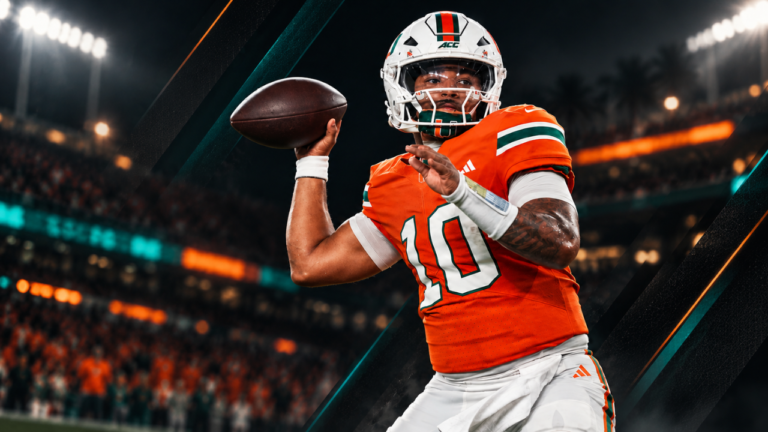
The final spots were close. Miami quarterback Darian Mensah and Notre Dame quarterback CJ Carr were the next two quarterbacks in the conversation, in that order. Ole Miss running back Kewan Lacy was narrowly behind Baugh, while Oregon tight end Jamari Johnson, Alabama edge Yhonzae Pierre and Mississippi State corner Kelley Jones all received serious consideration. Georgia linebacker Chris Cole, Miami defensive tackle Justin Scott, Indiana receiver Nick Marsh, Rutgers receiver KJ Duff and Iowa defensive back Zach Lutmer were also just outside the top 25.
Who do I have too high? Who is too low? And who did I leave out? Let me know and stay with Fins Faithful for draft coverage throughout the season.